Why Bitcoin Traders Keep Using Leverage (And Why You Shouldn't)
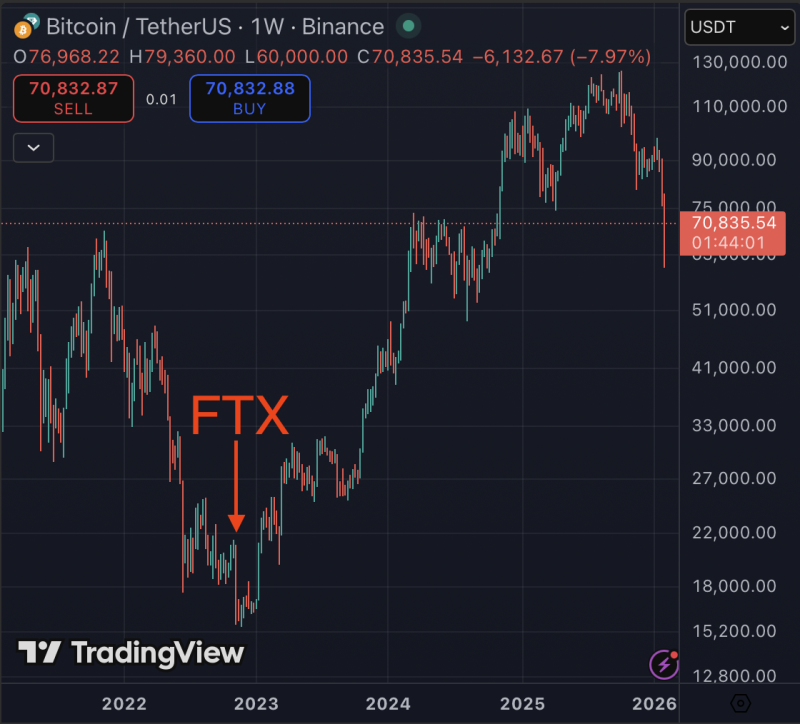
This week's Bitcoin price slide offers a textbook example of a market paradox: spot buyers were actively accumulating, ETFs saw positive inflows, yet the price kept dropping. The culprit? Leveraged positions in the derivatives market overwhelmed actual Bitcoin buying by a ratio of nearly 8:1 on some exchanges. Last week saw Bitcoin’s worst day since the FTX collapse.

If you're wondering why - after years of spectacular blowups, liquidation cascades, and fortunes vaporised - people still use leverage to trade Bitcoin, you're asking the right question. The answer reveals something important about human nature, market structure, and why simply holding Bitcoin remains the superior strategy.
What Is Leverage, Briefly
Leverage in Bitcoin trading means borrowing capital to control a position larger than your actual holdings. If you have $10,000 and use 10x leverage, you're controlling a $100,000 position. When Bitcoin moves 1% in your favor, you gain 10%. When it moves 1% against you, you lose 10%.
The mechanism varies by platform. Perpetual futures contracts (the most popular form) use a funding rate system to keep prices anchored to spot markets. Margin trading on exchanges lets you borrow directly against collateral. Options give you the right to buy or sell at a specific price. All share the same core feature: they amplify both gains and losses.
Why Do People Keep Using It?
After watching the 2021 leverage wipeout, the 2022 implosions, and countless smaller cascades, why does leverage persist?
The math looks compelling. On paper, 10x leverage turns a 10% Bitcoin move into a 100% gain. If you "know" Bitcoin is going to $100,000, why slowly accumulate when you could control ten times as many coins with the same capital? The calculus ignores that you don't know, that volatility will hunt your liquidation price, and that timing is nearly impossible.
Trading feels productive. Holding Bitcoin requires patience, which feels passive. Leverage trading offers constant action, decisions, small wins that trigger dopamine. You're doing something. The psychological reward system favors activity over stillness, even when stillness produces better outcomes.
Survivorship bias is powerful. Social media amplifies the winners. Someone turning $1,000 into $50,000 with 50x leverage gets attention. The dozens who lost everything the same week stay quiet. New traders see the wins, not the statistical graveyard.
Short-term thinking dominates. Leverage is a tool for capturing immediate moves. It's incompatible with multi-year thinking. But humans are wired for immediate feedback. A potential 3% gain today activates different brain circuitry than a potential 300% gain over five years.


Bitcoin Open Interest (current leveraged positions open) Monday 9 February 2026
The Types, Amounts, and Risks
Perpetual futures are the most common. Exchanges offer 5x, 10x, 25x, 50x, even 100x+ leverage. You deposit collateral, open a position, and pay or receive funding rates every eight hours based on whether you're long or short relative to the broader market. If Bitcoin moves against you by the inverse of your leverage (1% move against you at 100x = liquidation), your position is automatically closed and your collateral is gone.
Margin trading lets you borrow Bitcoin or stablecoins against your holdings. If you have 1 BTC worth $70,000 and borrow another $70,000 in stablecoins to buy more Bitcoin, you've created 2x leverage. The exchange charges interest and will liquidate your position if the value drops below the maintenance margin threshold.
Options provide leverage through premium costs rather than borrowed capital. A $70,000 call option might cost $2,000, giving you exposure to upside with limited downside. But options expire worthless if Bitcoin doesn't reach your strike price, and complexity increases significantly.
The supposed rewards are obvious: amplified gains. A 20% Bitcoin rally with 5x leverage becomes a 100% gain. The actual risks are often underestimated. Liquidation happens faster than you think. Bitcoin has moved 10% in an hour multiple times. At 10x leverage, that's complete loss. At 50x leverage, a 2% move against you is catastrophic. Even if your long-term thesis is correct, short-term volatility can eliminate your position before the thesis plays out.
This week demonstrated the structural risk. Derivatives volume was eight times spot volume on Binance. When leveraged longs started getting liquidated, it triggered a cascade. Each liquidation became a forced market sell, pushing price lower, triggering more liquidations. The spot buyers couldn't absorb the synthetic selling pressure created by unwinding leveraged positions. Price discovery shifted from actual Bitcoin changing hands to collateral being force-liquidated.

Why Hodling Wins
The pragmatic case for holding Bitcoin without leverage rests on three foundations.
Volatility can't hurt you. Bitcoin has experienced drawdowns exceeding 80% multiple times in its history. Spot holders who maintained conviction recovered and then some. Every single leveraged position during those drawdowns was liquidated. Volatility is a feature of Bitcoin, not a bug. Leverage transforms a feature into a fatal flaw.
Time is the variable you control. You can't predict where Bitcoin will be next week. You can be reasonably confident about its trajectory over five to ten years given supply dynamics, adoption curves, and monetary policy trends. Leverage requires being right about direction and timing. Holding requires only being right about direction and having patience.
The opportunity cost is real. Every Bitcoin you lose to liquidation is gone. If Bitcoin reaches $500,000 in 2030, that's not just the current dollar value you lost - it's the $500,000 you won't have. Leverage trades short-term gambling for long-term wealth building.
This week's price action crystallized the dynamic. Spot buyers were accumulating. ETFs saw inflows. Exchange reserves were rising. Yet price fell because the marginal trade was happening in derivatives, where synthetic exposure was being violently unwound. The Bitcoin you hold in your wallet couldn't be liquidated. The synthetic exposure on leveraged platforms was systematically destroyed.

“BFR” - the Bitcoin Funding Rates show what traders are paying to keep their positions open. Extremely positive rates (longs paying shorts) indicate overleveraged bullish positions right before crashes
Bitcoin's scarcity is its fundamental value proposition. There will only ever be 21 million coins. Leverage creates synthetic scarcity by allowing the same underlying Bitcoin to back multiple positions simultaneously. When you hold Bitcoin outright, you own a fixed percentage of a fixed supply. When you trade leverage, you own a conditional claim on value that can be zeroed out by price movements that don't change Bitcoin's long-term trajectory at all.
The peace of mind calculation is simple. Can you hold through a 30% drawdown without losing sleep? If yes, spot holding works. Can you hold through a 30% drawdown when you're leveraged 5x, knowing you'll be liquidated at 20%? That's not investing. That's hoping volatility takes a week off.
Bitcoin doesn't reward cleverness or timing or trading skill over the long run. It rewards patience, conviction, and the discipline to do nothing. Every person who got wealthy from Bitcoin did so by buying and holding. Every person who blew up did so by trying to optimise, trade, or leverage their way to faster gains.
The market will keep offering leverage. Human nature will keep accepting it. But understanding why it exists, why people use it, and why it fails can save you from learning the expensive way.