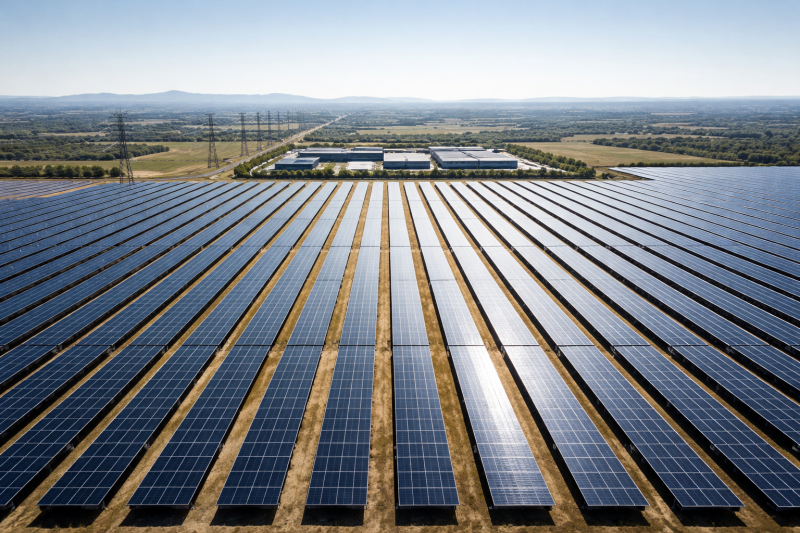
Solar power has entered a new era. It has become the fastest-growing source of electricity capacity in the world and, in many regions, the largest renewable generation capacity overall. In the European Union, solar has already overtaken coal in annual electricity generation – an important milestone in the energy transition. Global solar capacity recently surpassed 2 TW, more than any other renewable category and expanding rapidly year-on- year.

That achievement reveals both the promise and the challenge of renewable energy. Solar produces the most power when the sun is high, but demand does not always align with that midday peak. Today’s grids were not designed around a world where large amounts of energy can appear (and disappear) with the weather.
As solar penetration increases, operators more frequently encounter periods where generation exceeds what the grid can absorb or transmit. To keep supply and demand balanced—which is essential for grid stability—they curtail renewable output, meaning potential energy that couldhave been produced is intentionally not used. This is not theoretical: in Texas, for example, combined wind and solar curtailment has already reached several terawatt-hours, and projections show curtailment rising if transmission capacity does not keep pace with generation growth.
Curtailment represents unused clean energy. It does not harm the grid, but it signals a structural imbalance between supply and flexible demand.

Enter the idea of flexible load.
Large, interruptible electrical loads that can scale up when energy is abundant and reduce demand quickly when it isn’t are extremely valuable to modern grids. Unlike most industrial consumers, Bitcoin mining facilities can turn down or off their power usage within minutes without damaging production lines or risking safety—because their primary product is computational work that can pause without consequence.
That capability is exactly what grid operators increasingly need as renewable penetration grows. A growing academic literature identifies Bitcoin mining as one of several potential flexible load categories that can support grid balancing and mitigate curtailment. In simulations of grid operations with high renewable shares, Bitcoin miners helped reduce feed-in congestion and absorb excess renewable energy that would otherwise be curtailed.
Peer-reviewed research also suggests that, under renewable-heavy scenarios, flexible mining loads could function similarly to conventional demand-response or storage assets. If configured to respond to real-time grid conditions, mining can help buffer supply fluctuations and accelerate the economic viability of renewable projects.

It’s not an idea, it works - Now
In Texas—one of the world’s fastest-growing solar markets—this behaviour can be observed in real time. The Electric Reliability Council of Texas (ERCOT) region regularly curtails wind and solar when generation outpaces local demand and transmission capacity. In 2024 alone, grid congestion forced over 8 TWh of wind and solar energy to be curtailed, a figure that echoes trends in other high-renewables systems.

Texas also offers one of the clearest empirical case studies of Bitcoin mining behaving as flexible load. During extreme weather events, mining operations in ERCOT have sharply reduced their hashrate—effectively reducing electricity demand—when prices spiked and system stress increased. These adjustments occur rapidly and without physical disruption to mining infrastructure, and the Bitcoin network adapts through its difficulty adjustment mechanism. In practice, this means mining demand helps stabilise the grid rather than exacerbate strain.
This responsiveness has several implications:

-
For renewables: Flexible Bitcoin demand can shift consumption into periods of surplus generation, reducing curtailed energy and improving project economics by providing a predictable off-taker for clean power.
-
For grids: Interruptible loads reduce reliance on emergency generators and conventional demand-response programs that often require longer notice.
-
For system costs: Better alignment between generation and load can reduce price volatility and the need for costly transmission upgrades in the short run, while broader market reforms catch up.
It is important to stress that flexible load is not a silver bullet. Transmission capacity, storage, and other forms of demand response are crucial. Bitcoin mining does not replace these options. It should be evaluated as one tool among many, with clear protocols to ensure load is truly interruptible and aligned with grid needs rather than subsidised flatly regardless of system conditions.
Nevertheless, as solar continues to expand and curtailment becomes more frequent in high-penetration markets, the question isn’t just whether energy is being used, but how it is being used.
A load that can help soak up surplus clean energy and reduce demand when the grid is stressed is not a liability. It is a form of flexibility that grids increasingly need.
Seen in this light, Bitcoin mining is not merely an energy consumer. It is a flexible energy asset that—if integrated thoughtfully—can support renewable integration, improve grid reliability, and help put otherwise curtailed clean energy to economic use.